Kioxia beats its own world record with the fastest SSD ever produced — new PCIe 6.0 GP1 tops 20M IOPS and is part of Kioxia's plan to challenge DRAM in AI markets
Kioxia wants to take on DRAM with flash storage, and its newest SSD brings random-read speeds above 20 million IOPS.
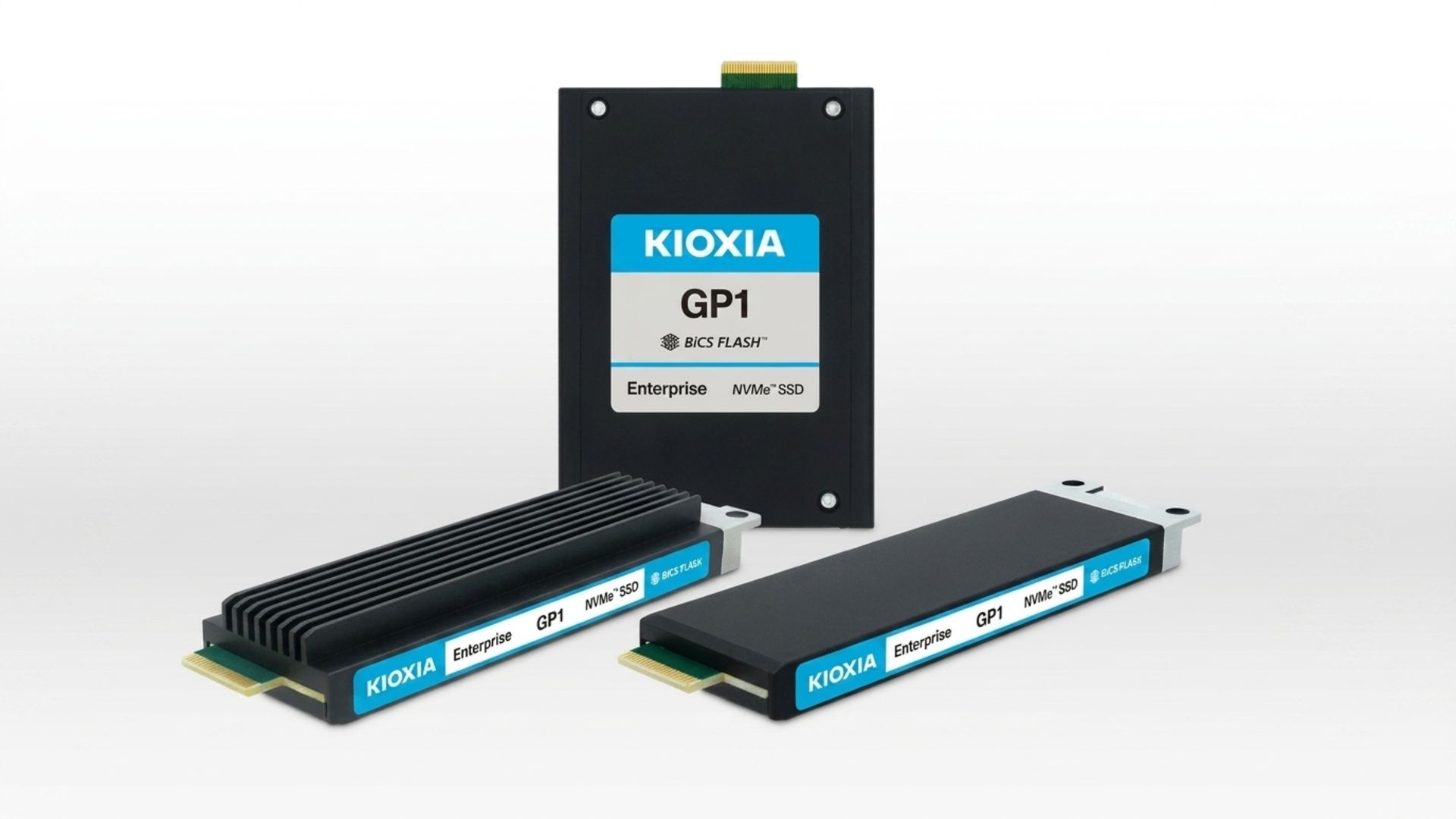
Kioxia's upgraded GP drive exceeds 20 million random-read IOPSThird-gen XL-FLASH improves memory access through shorter wiring and additional planesKioxia LD4 launches with 15.36 TB and 30.72 TB capacitiesKioxia has announced a faster edition of its GP series drive that exceeds 20 million IOPS when reading 512-byte data blocks at random.The GP1 unveiled in August 2026 delivered about 10 million IOPS, so the new version roughly doubles the speed of the earlier model.The faster model relies on third-generation XL-FLASH memory, which delivers three times the reading speed and roughly 150% higher writing speed than before.How flash is meant to rival DRAMThe company is pursuing a plan to take on DRAM in AI markets by offering flash storage that approaches memory-class speed.“Kioxia is making game-changing high-performance flash storage solutions for AI infrastructure,” said Neville Ichhaporia, SVP and GM of the SD business unit at Kioxia America.“As AI drives new performance demands, scalable, efficient storage becomes the foundation for innovation.”Its XL-FLASH technology is designed to deliver higher operation rates, finer 512-byte access and lower power per operation than conventional SSDs.The third-generation XL-FLASH shortens its word and bit wiring to cut RC delay and fits more planes in each die than the 16 of Gen 2.Its efficiency is forecast to rise roughly 40% for reads, and 80% for writes, yet energy used by each operation is expected to keep climbing.The first-generation GP1 uses MLC cells storing 2 bits, a faster SLC mode, a 16-plane layout, and read latency below 5 microseconds.It is a PCIe 6.0 NVMe 2.2 drive meant for GPUs to reach storage directly, with endurance rated at up to 50 DWPD.Kioxia has not disclosed the upgraded model's endurance rating or confirmed whether it keeps the PCIe 6.0 interface, but it will most likely follow the path of its predecessor.LD4 arrives without performance figuresKioxia also exhibited the LD4, a QLC drive with one port that stores 4 bits per cell in E1.L format using a four-lane PCIe 5 link.It comes in 15.36 TB and 30.72 TB capacities, though its design can scale to 122.88 TB for hyperscalers, which is still modest compared to the Kioxia LC9’s 246 TB capacity.The 15.36 TB model fills a quarter of the E1.L enclosure, with a 61.44 TB version likely at the three-quarter point.The LD4 uses 218-layer BiCS 8 flash and appears to succeed the October 2023 LD2, which ran on PCIe 3 with identical capacities.It also supports NVMe 2.0, OCP specification 2.6, and full-path safeguards against data loss.Kioxia skipped an LD3, so the LD4 follows the LD2 after roughly three years and swaps in a faster PCIe 5 bus.Rival E1.L drives with a PCIe 5 interface include the 6550 ION from Micron, the R6060 from DapuStor and the Echo from FADU.As of the time of writing, the company has not released the speed or durability figures for the LD4.Via Blocksandfiles